
What Is the Rh Blood Group System? A Complete Guide
Aside from A, B, AB, and O blood types, the Rh blood group system constitutes another dimension to blood typing blood. These are relevant to transfusion medicine, care during pregnancy, and laboratory tests. While many merely identify it as the Rh factor or Rhesus factor, it is beyond being Rh positive or Rh negative.
The Rh blood group system consists of inherited markers present on the membranes of red blood cells. These markers, or red cell membrane antigens, are used by physicians to assess the possible compatibility of two individuals’ blood types and the possibility of an immune response to any transfusion. Because of the predominance of the RhD antigen, individuals are commonly categorized as Rh positive or Rh negative.
This guide will explain the history, the genetic and methodological aspects of blood typing, the implications of Rh antibodies, maternal and fetal safety during pregnancy, and the clinical relevance of transfusion medicine and the Rh system.
What Is the Rh Blood Group System?
Second only to the ABO blood group system, the Rh blood group system is one of the largest blood group systems in the field of human medicine. It serves to identify the presence of certain blood group antigens found on the membrane of red blood cells. These antigens, which can affect the donor-recipient compatibility of blood transfusions, are inherited from the parents, and their presence is not universally common across the entire population.
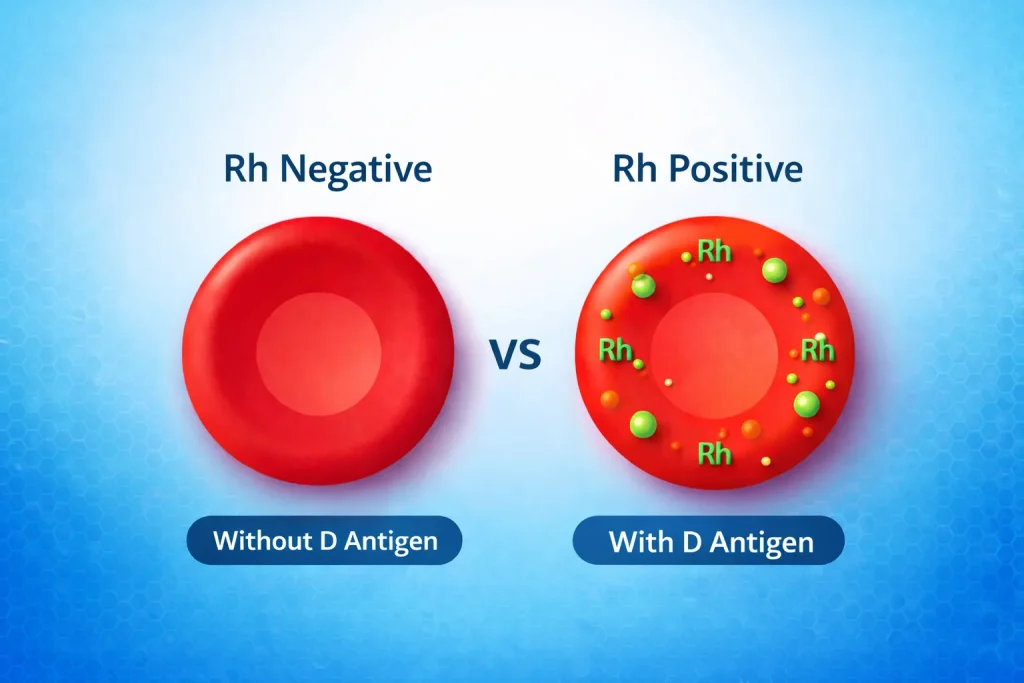
The discussion surrounding the Rh factor largely pertains to the presence or absence of the D antigen on red blood cells. In the Rh blood group system, people who have the D antigen are considered Rh positive. On the other hand, those who do not have the D antigen are Rh negative. Thus, the D antigen is clinically significant in the Rh blood grouping system.
The Rhesus blood group system is another name for this same system, while Rh factor tends to be the common name in reference to this system. It is especially common in blood testing and during pregnancy. It is important to note, though, that while the system is often referred to as the RhD system, that is not entirely accurate because there is more than one antigen within this system.
Origin of the Rh Factor
The Rh factor was discovered in the process of determining blood compatibility in the early 1940 by Karl Landsteiner and Alexander Wiener, which was the first step to explaining complications in blood transfusions and the transfusion of different Rh types to the fetus in pregnant women.
The term ‘Rhesus factor’ was based on studies involving rhesus monkeys, but the modern understanding of the human Rh system is far more complex. With each passing year, scientists were able to explain modern immunohematology and safer blood matching practices with more than just Rhesus blood group systems and one single factor.
Genetics of the Rh Blood Group System
Rhesus blood is far more complex and fascinating than the average person knows, particularly within the Rh blood group system, where the RHD and RHCE genes play a key role. The RHD gene indicates whether the D antigen is present and is a factor in blood types Rh+, while the RHCE gene is responsible for the other, more predominant, C, c, E and e antigens. With one or both of these genes, antigens are produced, blood types are classified, and Rhesus pattern phenotypes are established.
Traits like these are passed down through generations, allowing the Rh phenotype to be tracked through the family tree. This can lead to incompatibility between mother and baby, as some blood groups can be mismatched. This system also demonstrates the blood group system’s multiple alleles, which are different related genes that dictate the different antigens expressed on the surface of red blood cells.
What Does Rh Mean In Blood?
A common question is: what does the Rh factor in blood actually mean? It means the presence and absence of the D antigen in the red blood cells. Simply put, it is used to state whether there is presence of the rhesus protein in the blood cells or not. More specifically, there are additional antigen expression variations involved, but this is the basic idea in clinical practice.
People that are D positive are referred to as Rh positive blood group, and people that do not possess it are referred to as having Rh negative blood group. This is very important in blood transfusion, management of pregnancy, and in monitoring the immune response.
Rh Positive vs. Rh Negative: What Distinguishes Them?
The detail that differentiates Rh negatives from Rh positives is the presence of the D antigen. Rh positives have the D antigen, while Rh negatives do not.
In most cases, this difference is not significant, but it becomes crucial during blood transfusions or pregnancy, but when receiving blood transfusions or during pregnancy, this difference is crucial. If an Rh negative person receives blood from an Rh positive person, they may develop an immune response that causes them to produce antibodies to the Rh antigens.
The Rh Compatibility Chart
| Recipient Type | Can Receive Red Cells From | Can Donate Red Cells To |
|---|---|---|
| A+ | A+, A-, O+, O- | A+, AB+ |
| A- | A-, O- | A+, A-, AB+, AB- |
| B+ | B+, B-, O+, O- | B+, AB+ |
| B- | B-, O- | B+, B-, AB+, AB- |
| AB+ (Universal Recipient) | All ABO/Rh types | AB+ |
| AB- | AB-, A-, B-, O- | AB+, AB- |
| O+ | O+, O- | O+, A+, B+, AB+ |
| O- (Universal Donor) | O- | All ABO/Rh types |
O-Negative is the Universal Red Cell Donor because it lacks A, B, and D antigens, making it the safest blood type for emergency use when a patient’s type is unknown.
Why Does The RhD Antigen Matter
The RhD antigen is the most clinically significant antigen in the Rh system. If what is clinically regarded as the RhD antigen comes and comes in contact with Rh positive blood, the result is the strongest possible immune system response.
Because of this, what is clinically referred to as the D antigen is what we primarily concern ourselves with when we are determining Rh typing, matching blood for transfusions, and during pregnancy. It is a significant component of no blood type determination and pregnancy process.
Main Antigens in the Rh System
In the Rh blood group system, the principal antigens are D, C, c, E, and e. Blood typing and the corresponding investigations on blood groups and transfusions and immunological pregnancy issues are mostly focused on these five antigens, the principal Rh antigens.
The most significant antigen is D, but the other four are also essential, as antibodies may form against them, particularly in the case of multiple blood transfusions, as well as in pregnancy. These antigens are all products of the RHD and RHCE genes and are indispensable in immunohematology and blood banking.
| Antigen | Clinical Importance | Where It Matters Most |
|---|---|---|
| D | The most important Rh antigen | Blood typing, transfusion safety, pregnancy screening |
| C | One of the major Rh blood group antigens | Extended blood matching and antibody investigations |
| c | A clinically significant Rh antigen | Transfusion medicine and alloantibody screening |
| E | An important antigen in the Rh blood group system | Blood bank testing and compatibility workup |
| e | A common and clinically important Rh antigen | Antibody screening, transfusion compatibility, and prenatal testing |
Function of Rh Proteins
The function of most Rh proteins in the Rh blood group system is still unknown. What is known is that they play important roles in the structure of membranes of red blood cells. More than the labels that indicate blood groups, these proteins contribute to the overall structure of cell membranes and may have roles in the transport functions of red blood cells.
It is suggested that Rh proteins could also play a role in the transport of different molecules through the membranous structures of the red cell. The proteins linked to Rh antigen, with this proposed function, maintain the structural integrity of the red blood cell.
Antibodies Formed in Response to Rh Antigens
In an Rh-negative individual, antibody formation can occur during pregnancy with an Rh-positive fetus or after a blood transfusion due to sensitization to Rh-positive red blood cells.The individual will mount an immune response to the Rh antigens, which results in the formation of alloantibodies.
The formation of anti-D antibodies is the most common, but antibodies may also arise in response to the antigens C, c, E, and e. Antibodies to these antigens may be clinically significant because of their ability to destroy red blood cells that express the corresponding antigen. The implications of such destruction may include delayed transfusion reactions, pregnancy losses, or hemolytic transfusion reactions.
What Method Is Used To Determine Rh Blood Group?
The determination of blood groups, particularly the Rh blood group, is commonly achieved through an assessment of the D antigen on the red blood cells.
This assessment forms part of the blood grouping that is done routinely, during the antenatal phase, or while screening blood donors, or prior to performing a blood transfusion.
How Does the Test Work?
Typically, the lab combines a blood specimen with anti-D reagent and checks for agglutination as a part of the blood test.
- If agglutination occurs, the specimen is determined to be Rh positive.
- If agglutination does not occur, and especially if a weak expression is suspected, additional testing is typically warranted.
What If Results Are Unclear?
Sometimes, the D antigen is weakly expressed. In such cases, additional testing is required, including:
- RhD typing
- Serological blood typing
- Advanced red cell testing methods
These tests help confirm accurate results.
Rh Testing in Newborns
In the case of newborns, especially when the mother is Rh negative, testing may be performed post-delivery to assess the baby’s blood type or cord Rh testing, which may help determine the need for additional intervention.
Why Rh Compatibility Matters in Blood Transfusions
When doing a blood transfusion, the need for blood to be Rh compatible is very important. If Rh incompatible blood is transfused, the patient’s body will begin to produce antibodies, which is not the case when blood is transfused that is antigen compatible. There is a risk that the patient will produce antibodies or have red blood cells destroyed in other transfusions.
Therefore, blood banks assess more than just the ABO type compatibility. They assess compatibility of blood for transfusion, especially in relation to Rh status and, when applicable, additional antigen matching. In many cases, this is before issuing the blood and indicates whether the transfusion is compatible or incompatible.
What Is Rh Incompatibility?
Rh incompatibility is blood-type incompatibility for a person with Rh-negative blood being exposed to Rh-positive red blood cells. This is a significant problem with respect to pregnancy, but it can happen as a result of a blood transfusion as well.
Upon exposure, the immune system can regard the Rh-positive cells as foreign cells. Antibodies are then produced. This process is known as sensitization. With time, it can lead to severe complications in future pregnancies and blood transfusions.
Rh Factor and Pregnancy (Rh Incompatibility)
The most well-known and clinically sensitive feature of the Rh blood group system is the connection between the Rh factor and pregnancy. Complications can only occur when the mother is Rh-negative and the baby is Rh-positive (i.e., Rh Incompatibility).
How It Happens
- Situation: An Rh-negative mother conceives a child with an Rh-positive blood type (involves an Rh-positive or a Rh carrier father).
- Initiating Event: In the course of the pregnancy, but mainly at the time of giving birth (during delivery, a spontaneous abortion, or a medically induced abortion, or any of the various intrauterine diagnostic procedures), the mother can, in most cases, have a very small contamination with the fetal Rh-positive blood.
- Maternal Antibody Response: In case the mother conceives again with an Rh-positive child, her immunological memory cells surge and produce an unusually high quantity of anti-D antibodies. These antibodies, unlike the other blood group system antibodies, are small enough to cross the placental barrier and enter the fetal side of the circulation, where they destroy the fetal erythrocytes.
- The Risk for Subsequent Pregnancies: If the mother conceives again with another Rh-positive baby, her immune memory cells rapidly respond to produce anti-D antibodies. In contrast to ABO antibodies, anti-Rh antibodies are placentally small and therefore cross the placenta, and enter the fetal circulation to start attacking the fetal red blood cells.
Risk Factors In The Case Of An Rh Negative Mother And An Rh Positive Child
There are several risks when an Rh-negative mother is carrying an Rh-positive baby:
- The mother’s immune system may produce anti-D antibodies if fetal blood mixes with her blood.
- These antibodies can affect future pregnancies by attacking the baby’s red blood cells.
- The baby may develop conditions such as anemia (low red blood cells).
- Jaundice (yellowing of the skin) can also occur in the baby.
- In severe cases, it may lead to serious prenatal or postnatal complications.
- Without proper treatment, the risk to the baby increases significantly.
How Does Anti-D Injection Help Prevent Complications?
The anti-D injection, also known as Rho(D) immune globulin, helps prevent sensitization in Rh-negative mothers. It works by clearing fetal Rh-positive cells before the mother’s immune system reacts to them.
This treatment is commonly given during pregnancy, after delivery if the baby is Rh positive, and after events that may expose the mother to fetal blood. By preventing the formation of anti-D antibodies, it greatly reduces the risk of Rh alloimmunization and protects future pregnancies.
What Is Hemolytic Disease of the Fetus and Newborn (HDFN)?
Hemolytic disease of the fetus and newborn (HDFN), also known as erythroblastosis fetalis, is a condition that results from the destruction of fetal red blood cells by maternal antibodies that cross the placenta. HDFN leads to fetal hemolysis which may result in anemia, fetal edema, or in the most severe cases, death.
HDFN causes jaundice and anemia in the baby, which can be treated with supportive care, in the milder cases. Oxygen delivery to fetal tissues may be compromised and can place the fetus under significant stress when HDFN is more severe.
After delivery, in cases of HDFN from Rh incompatibility, the baby may develop newborn jaundice. Many of these cases will require, from a clinical standpoint, intensive intervention and possibly blood monitoring, exchange transfusion, or phototherapy. Risk assessment in the newborn is guided by cord blood testing, which includes testing of the cord blood Rh status.
There is a high clinical value in the screening of the Rh blood group system, and HDFN is a clear example of it. HDFN requires careful monitoring to prevent the development of severe complications.
Rare Rh Phenotypes
Rh typing can sometimes return nonstandard or atypical types. These types can have significant implications on blood grouping, possible transfusions, and management during pregnancies. Uncommon types can cause additional testing and confusion during routine testing or increase the potential for unexpected antibodies to develop.
Weak D
Weak D indicates a patient has D antigens that have a substandard expression. In the laboratory testing, this can occur with a negative or not definitive result. Weak D can result from a number of changes to the RHD gene, and is also caused by the strong expression of the D antigen.
This has clinical relevance, as a patient with Weak D can be designated as different depending on the clinical context. In blood donation, transfusion decisions, and pregnancy care, laboratories may use additional methods to clarify the result.
Partial D
Partial D means the D antigen is present, but some parts of it are missing or altered. An individual with Partial D can develop antibodies that target the missing areas if exposed to D-positive blood.
This is pertinent to both obstetric care and transfusion medicine. Detailed RhD typing and careful interpretation are necessary, especially when considering patients with atypical serologic findings or individuals with suspected RhCE variant(s). This case is particularly true when Partial D is considered.
Rh null
A rare blood group resulting from the absence of all Rh antigens from the surface of the red blood cells is called Rh null blood. It is often associated with the presence of red blood cells that are deformable, less stable in the membrane, and have shorter survival.
Due to the absence of all Rh proteins, red blood cells are likely to become more fragile and have chronic hemolytic problems. This blood group is rare, but also it is often the case that individuals with Rh null face difficulties in finding compatible blood.
Clinical Significance of the Rh Antibodies
The presence of Rh antibodies is significant from the standpoint of the blood bank but also from the laboratory. Once formed, these antibodies can affect pregnant women and the transfusion. It means more careful matching and closer follow-up of the clinical case in the future, and in many cases, the absence of these antibodies requires complex and careful actions.
Effects of Blood Transfusion
Relevance in Pregnancy
During pregnancy, evaluating maternal Rh antibodies is important, as maternal antibodies can pass through the placenta and destroy the fetal red blood cells. This can cause fetal anemia and can cause jaundice in the neonate and even more serious consequences if it is not identified early.
The most recognized case is the case of the anti-D antibodies, however, other Rh- antibodies are also of clinical importance. Appropriate prenatal care allows identification of the most concerned women to take timely prophylactic measures or monitoring.
In Alloimmunization and Patient Follow-Up
The presence of Rh antibodies is an indicator of Rh- alloimmunization, meaning the patient is sensitized by exposure to foreign red blood cell antigens, and once this occurs, they may remain of clinical importance for years.
This means that a patient might require ongoing documentation of their antibodies, repeated screenings, and specially matched blood for future admissions, operations, pregnancies.
Conclusion
The Rh blood group system is important for blood group tests, transfusion, and pregnancy management. It has many clinically relevant antigens, of which the Rh D antigen is the most relevant. It is important for patients and their families to understand the implications of the blood group system, why blood groups and antibodies are tested and the difference between Rh positive and Rh negative blood.
There is much more to the subject than the plus and minus sign of a blood group report. It involves the genetics of the RHD and RHCE genes, the anti-D injection used to manage pregnancy. In addition, knowledge of the Rh blood group system contributes to improved transfusion safety, better management of pregnancy, and more awareness of immune problems.
For readers following educational updates from an MFZ Clinical Lab blog, this topic is especially useful because it connects laboratory science with practical health awareness in an easy-to-understand way.
FAQS:
1. What is the Rh blood system?
The Rh blood group system is a method of classifying blood based on the presence or absence of the Rh factor on red blood cells. If the factor is present, the blood is Rh-positive; if absent, it is Rh-negative.
2. Why is Rh called “golden blood”?
Golden blood usually refers to Rh-null blood, a very rare blood type that has no Rh antigens on red blood cells. It is called “golden” because it is extremely rare and can be very valuable for helping patients with rare blood-matching needs.
3. Is Rh important in blood?
Yes, the Rh factor is important because it helps doctors match blood safely during transfusions and pregnancy. If Rh blood is not matched properly, it can cause serious health complications.
4. What race is mostly Rh negative?
Rh-negative blood is most commonly found in Caucasians and is also seen in some Indian populations, but it is generally less common overall than Rh-positive blood. It is less frequent in many African and East Asian groups.
5. What does Rh stand for?
Rh stands for Rhesus factor, a protein found on the surface of red blood cells. If you have it, your blood is Rh positive; if not, it is Rh negative. It is important for safe blood transfusions and during pregnancy.
Medical Disclaimer:
This article is for informational and educational purposes only. It is not a substitute for professional medical advice, diagnosis, laboratory interpretation, or treatment. For personal concerns about blood group testing, pregnancy screening, transfusion compatibility, or Rh antibodies, consult a qualified doctor or licensed healthcare professional.
